

Confused About Your Career? A 2026 Guide to Choosing the Right Field for Long-Term Success
Feeling confused about your career is more common than ever, especially in 2026. Whether you have just finished school or graduated from college, the pressure to make the “right” decision can feel overwhelming. With so many options available—jobs, freelancing, business, content creation—it becomes difficult to know which path will actually lead to stability and success.
The world is changing faster than ever. Artificial intelligence, automation, and rapid technological advancements are reshaping industries. Roles that existed a few years ago are evolving or disappearing, while new career paths are emerging every day. Choosing the wrong direction today can lead to years of struggle, frustration, and financial instability.
The reality is simple: many traditional entry-level jobs are being replaced or transformed by automation. That’s why making an informed and strategic career choice is no longer optional—it’s essential.
Why Most Youngsters Are Confused in 2026
Too Many Options
Today’s generation has more opportunities than ever before. You can build a career through a traditional job, start freelancing, launch a business, or even grow as a content creator. While this sounds exciting, it often creates confusion rather than clarity. Too many choices can make it harder to decide.
Social Media Pressure
Social media has created unrealistic expectations. Everyone seems successful, earning money, traveling, and living their dream life. This constant exposure can make you feel like you’re falling behind, even when you’re just getting started.
Lack of Real Guidance
Most schools and colleges still focus on theoretical education. They rarely teach practical career planning, market trends, or how to choose a path based on real-world demand. As a result, many students graduate without a clear direction.
Fear of Choosing Wrong
One of the biggest fears is wasting time. Many young people worry: “What if I choose the wrong field and lose four or five years?” This fear often leads to overthinking and inaction.
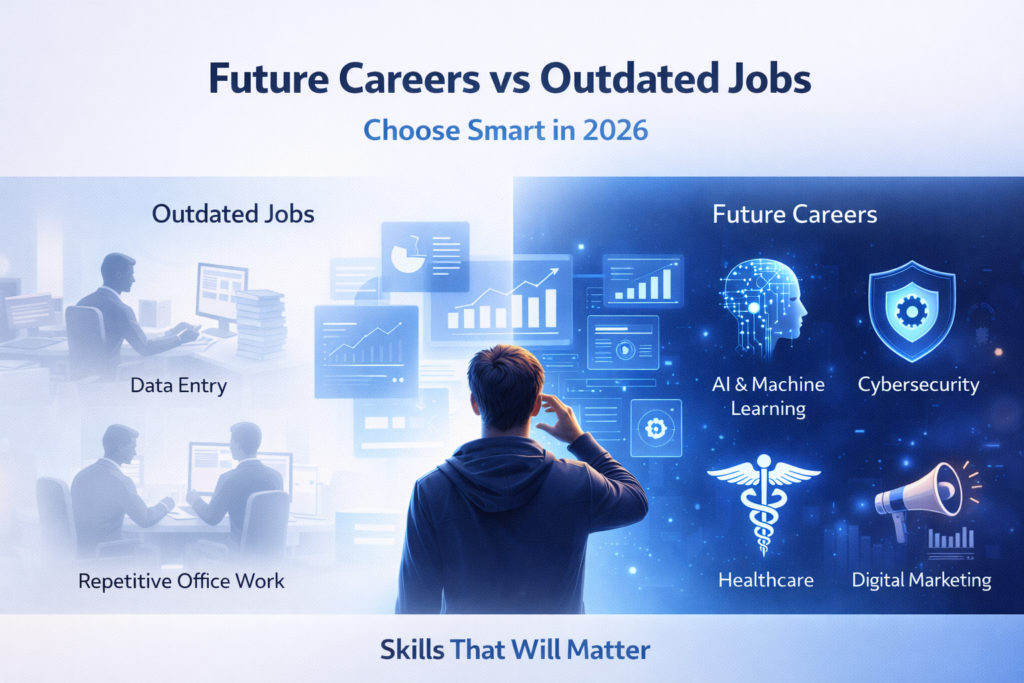
The Reality of Future Jobs (2026–2035)
The future of work is not about jobs disappearing completely—it’s about jobs changing. Artificial intelligence is transforming roles, not eliminating all of them. The biggest shift is that skills now matter more than degrees.
Employers are increasingly focusing on what you can do rather than what you studied. Practical knowledge, adaptability, and problem-solving abilities are becoming the most valuable assets.
At the same time, certain industries are growing faster than others. Healthcare, infrastructure, and sustainability-related sectors are expected to remain stable and in demand for the long term. These fields are driven by human needs and global challenges, making them less vulnerable to automation.
Top Career Fields That Will Stay in Demand (Next 10 Years)
AI and Data Careers
Careers in artificial intelligence and data are among the fastest-growing in the world. Roles such as AI engineers, data analysts, and machine learning specialists are becoming essential across industries.
Every company today relies on data to make decisions. This makes data-related careers highly valuable and future-proof.
Cybersecurity and Cloud Computing
As businesses move online, the need for security and cloud infrastructure continues to rise. Ethical hackers and cloud engineers are responsible for protecting systems and managing digital environments.
With increasing cyber threats, this field is expected to remain in high demand for years to come.
Healthcare and Psychology
Healthcare professionals, including doctors and nurses, will always be needed. In addition, mental health awareness is growing rapidly, increasing demand for psychologists and counselors.
These roles are deeply human-centered, making them difficult for AI to replace.
Digital Business and Marketing
The shift to online platforms has created massive opportunities in digital marketing and business strategy. Skills like performance marketing, content creation, and brand strategy are highly valuable.
Businesses need experts who can help them grow online, making this a strong and evolving career path.
Skilled Trades and Practical Fields
Skilled trades such as electricians, technicians, and mechanics are often overlooked but remain highly in demand. These roles offer stable income and lower competition compared to saturated white-collar jobs.
Renewable Energy and Climate Technology
As the world focuses on sustainability, careers in renewable energy and environmental science are growing rapidly. Solar engineers and environmental specialists are becoming key players in shaping the future.
Careers That May Decline
Not all careers are growing. Some roles are becoming less relevant due to automation and AI.
Repetitive office jobs, basic data entry roles, and low-skill administrative tasks are at risk. These jobs are easier to automate, making them less secure in the long term.
How to Choose the Right Career (Step-by-Step Guide)
Step 1: Understand Yourself
Start by identifying your strengths. Instead of focusing only on what you enjoy, think about what you can do well and improve over time. The key question is: “What skill can I develop that people are willing to pay for?”
Step 2: Check Market Demand
Before committing to a career, research whether it will still be relevant in the future. Look at industry trends and ask yourself if this skill will still be valuable in 2030 and beyond.
Step 3: Test Before Committing
Don’t rely only on theory. Try freelancing, internships, or small projects. This will give you real experience and help you understand whether a field is right for you.
Step 4: Choose One Skill
One of the biggest mistakes is trying to learn everything at once. Focus on mastering one high-value skill first. Once you build expertise, you can expand into related areas.
The Golden Rule for Career Success in 2026
The most effective way to choose a career is to combine three key factors:
Skill + Market Demand + Income Potential
For example, combining coding with artificial intelligence can lead to high-paying opportunities. Similarly, combining marketing with AI can create a powerful and future-ready career path.
Mistakes to Avoid
Many young people make avoidable mistakes when choosing a career.
Following friends without thinking independently can lead to poor decisions. Choosing a degree without researching job opportunities often results in disappointment. Frequently switching careers without giving enough time to learn can slow progress. Trying to learn too many skills at once can lead to confusion and lack of mastery.
Avoiding these mistakes can save years of effort and frustration.
Conclusion
There is no such thing as a perfect career. Success comes from making smart decisions and consistently building valuable skills over time.
The key is to start, even if you are unsure. Take small steps, test different paths, and focus on continuous improvement.
Your career is not defined by your degree, but by the skills you develop and how effectively you use them.