
Many ecommerce stores generate initial sales but struggle to grow consistently. The issue is rarely the product itself. In most cases, the real problem is the absence of a structured growth system.
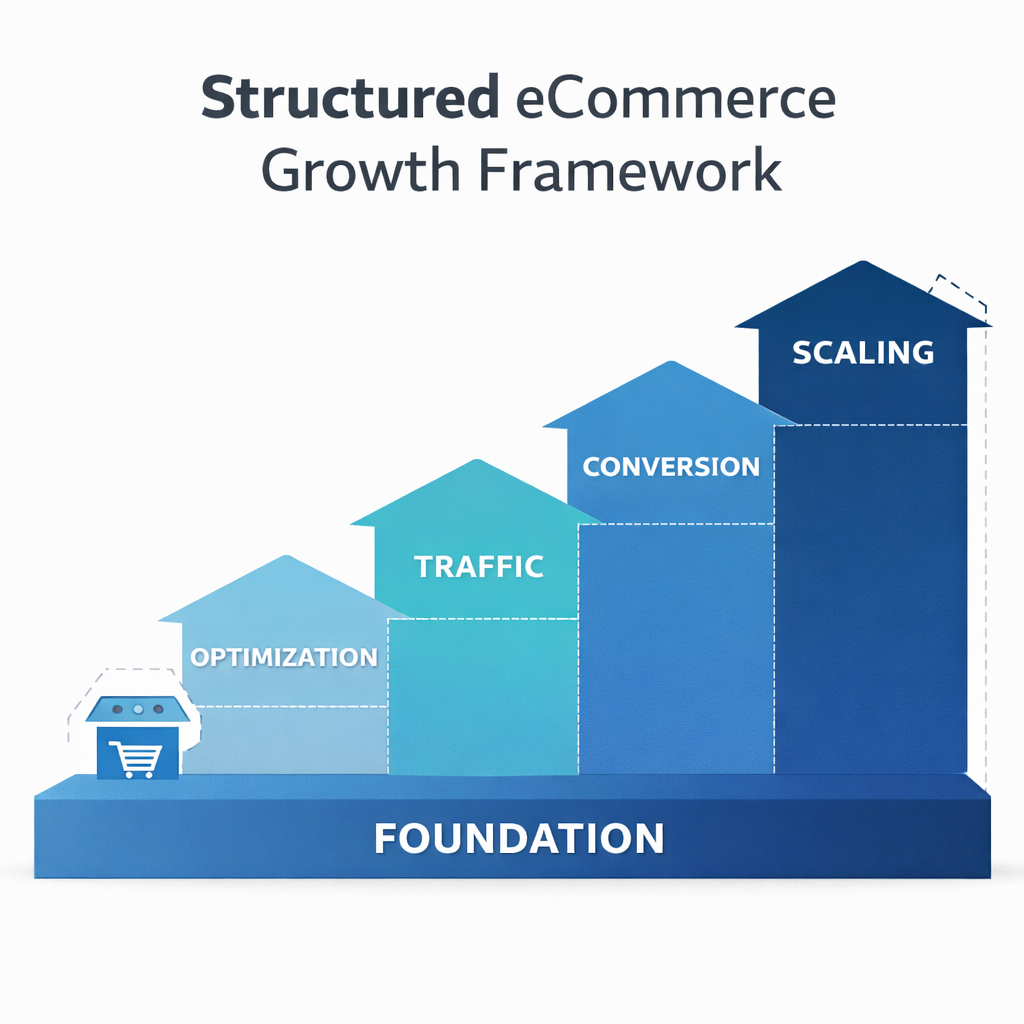
Scaling is not about running more ads or changing themes. It requires alignment between positioning, technology, traffic acquisition, conversion optimization, and data analysis.
This article explains why most stores fail to scale and how to build a sustainable system for long-term growth.
1. Lack of Clear Market Positioning
One of the biggest reasons stores fail is unclear positioning.
When a brand tries to target everyone, the message becomes weak. Customers do not understand:
- Who the product is for
- What problem it solves
- Why it is different
A scalable ecommerce business defines:
- A specific target audience
- A strong value proposition
- A clear brand identity
- Consistent messaging across all channels
Clarity builds trust. Trust drives conversions.
2. Weak Technical Foundation
A store cannot scale on a weak technical base.
Common technical issues include:
- Slow loading speed
- Poor mobile optimization
- Complicated navigation
- Broken tracking setup
- Unoptimized product pages
Even high-quality traffic will not convert if the website experience is poor.
A professional ecommerce setup focuses on speed, structure, usability, and tracking from the beginning.
3. Overdependence on Paid Advertising
Many businesses rely only on paid ads. When advertising costs increase, profit margins shrink.
Sustainable growth requires diversified acquisition channels:
- Organic SEO traffic
- Paid campaigns
- Email marketing
- Retargeting systems
- Marketplace presence when relevant
A balanced traffic strategy protects the business from platform risks and cost fluctuations.
4. No Data-Driven Optimization
Scaling without analytics leads to wasted resources.
Successful ecommerce brands continuously track:
- Conversion rate
- Cost per acquisition
- Average order value
- Customer lifetime value
- Cart abandonment rate
Data reveals bottlenecks. Optimization increases profitability without increasing traffic costs.
5. Ignoring Conversion Rate Optimization
Traffic alone does not guarantee growth.
Small improvements in:
- Product page structure
- Copy clarity
- Social proof
- Trust signals
- Checkout simplicity
can significantly increase revenue.
Improving conversion rate is often more profitable than increasing traffic volume.
Conclusion
Most ecommerce stores fail because they focus on tactics instead of systems.
Sustainable scaling requires:
- Strong positioning
- Technical stability
- Diversified traffic
- Continuous data analysis
- Ongoing conversion optimization
Businesses that build structured growth systems outperform those chasing short-term results.